Score Your GTM Stack: A Teardown Framework
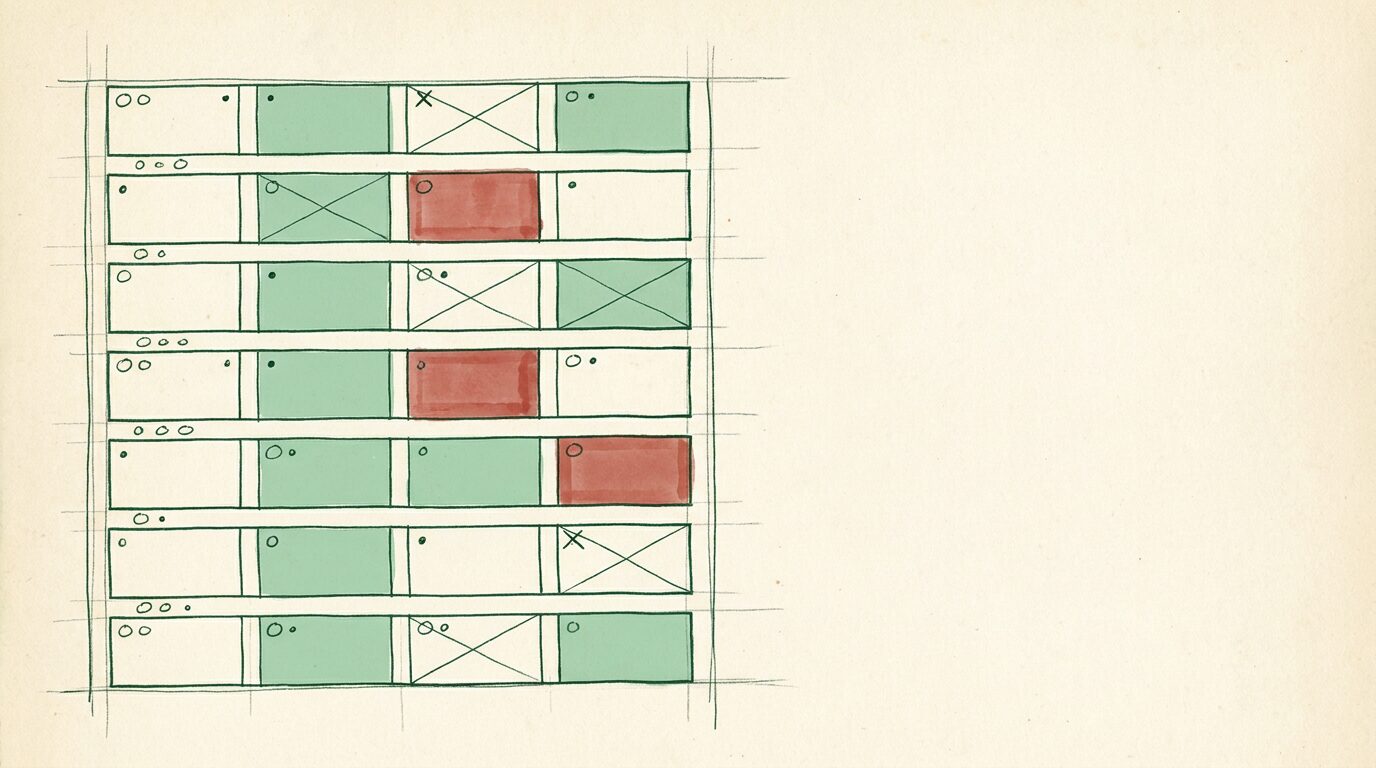
If you are buying agentic GTM tooling, score it on which loop owns which decision. Here is the framework we use in 30-minute teardowns.
The decision-ownership matrix
Every revenue motion is a sequence of decisions. Each decision has an owner. In a healthy GTM stack, the owner is explicit. In a broken one, the owner is whoever happens to be in the room.
We score four ownership states per decision:
- Agent-owned. The system makes the call. The human reviews after the fact, if at all.
- Human-owned. A specific human makes the call. The system supports.
- Contested. Both think they own it. Both act. Damage compounds.
- Leaking. Nobody owns it. The decision is made by default, by silence, or by deadline.
Seven loops every revenue org runs
A B2B revenue org typically runs seven decision loops in parallel:
- Targeting. Which accounts are buyer-ready right now?
- Matching. Which of our capabilities maps to this account’s stated priorities?
- Sequencing. What is the right order of touches for this account?
- Drafting. What does the outbound say?
- Sending. Does this actually go out?
- Escalation. When does a human need to step in?
- Learning. How does what we learned this week change the next batch?
The teardown scores all seven. The pattern that emerges is consistent: targeting, matching, and drafting are usually under-owned by the agent layer (or contested with humans). Escalation and learning are almost always leaking.
Scoring rubric
For each of the seven loops, mark the current owner and the desired owner. Highlight the deltas. A delta is either:
- Move to agent. The human is doing work the agent can do better.
- Move to human. The agent is doing work that requires judgment.
- Define the boundary. The work is genuinely contested and the architecture has not been drawn.
- Plug the leak. Nobody owns it. Someone must.
Worked example
A 12-person sales team at a Series B SaaS company runs the seven loops as follows:
| Loop | Current owner | Desired owner | Action |
|---|---|---|---|
| Targeting | Agent (incomplete) | Agent | Improve signal sources |
| Matching | Human | Agent | Move to agent |
| Sequencing | Human | Agent | Move to agent |
| Drafting | Human | Agent (gated) | Move to agent with threshold |
| Sending | Human | Human | Keep |
| Escalation | Leaking | Human | Plug the leak |
| Learning | Leaking | Human + Agent | Plug the leak |
Two leaks, three moves to agent, one keep. That is a six-week roadmap. It is also a buying brief: a vendor that cannot move matching, sequencing, and drafting into a gated agent layer is not the vendor.
How to run a teardown in 30 minutes
- 0–5 min. Sketch the seven loops on a whiteboard. Name the current owner of each.
- 5–20 min. For each loop, ask: when was the last time this loop made a decision you regretted? Why? Who would have caught it?
- 20–25 min. Mark each loop with its ownership state. Circle the leaks.
- 25–30 min. Draw the next architecture. One slide. No more.
The output is not a strategy document. It is a list of boundaries you are going to draw, in order.
Want us to run this on your stack? Request a teardown.